
“Welcome to Vision-wise Uttarakhand, and thank you for your contribution….
We are exploring the hopes, challenges, dreams, visions and plans of many people around Mussourie (a small city in the Himalayan foothills). We use visual thinking (dreams, comics, visions) – with stories, myths, poems or songs where needed. You are very welcome to draw or write, but otherwise we will draw or write what you tell us”.
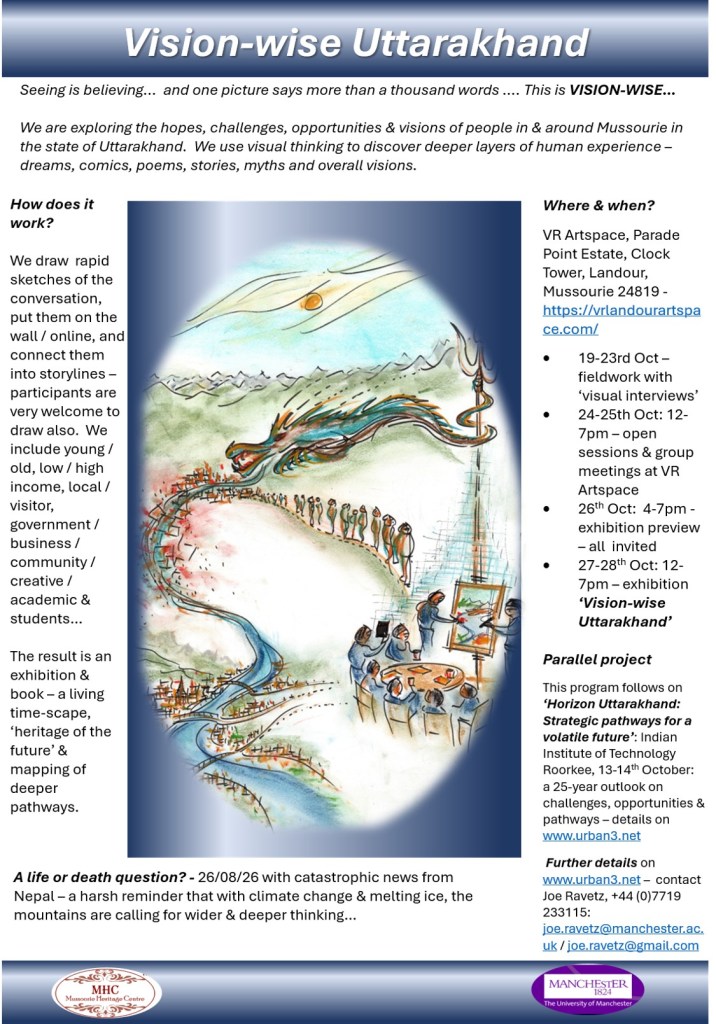
But then …. this plan was turned upside down by the catastrophic news from Rasuwa in Nepal of 26-08-26 … (this really got to me, as i had trekked up that valley in 1974, stayed in a Tibetan refugee village, then was marooned in a blizzard near Langtang…) The Himalayas are dangerous already, and more so as the ice gives way…. Dangerous both for residents with precarious livelihoods – and for pilgrims and explorers who are attracted to this extraordinary landscape. So how could the Vision-wise approach respond in Mussourie, 500 miles away?
We could draw pictures of monstrous floodwaters racing down the valley, taking bridges and houses and people… but maybe here we also draw pictures of how people think and feel. This could begin with the mythic layer, where the Trishuli river was made by Shiva the destroyer, as he drove his trident into the mountain… now on the trail of pilgrims who know their material lives are short and vulnerable. And then this connects somehow to the present day and practical questions, of how to live in such a place? how to build roads and bridges, houses and schools, right on the frontiers of natural forces versus human? Many layers are there to explore, not only dreams but fears, visions, traumas, hopes and plans…
BACKGROUND
Seeing is believing… and one picture says more than a thousand words ….
These are the powers of VISIONEERING – using participative visual thinking and communication, to understand complex problems, co-create shared visions, and design practical pathways to realize them. There are many other creative media – music, film, poetry – but visual thinking can get straight to the point.
Visual thinking is not only for pictures – it can unlock the synergies between a wider community of interest, deeper layers of value, and further horizons of change. This is the crucial collective intelligence, urgently needed in today’s world of challenge and crisis (also the focus of the Mind-Lab (‘Laboratory for Urban Collective Intelligence’), a global community working on the ‘pathways from smart to wise’.
At the centre are the ‘visioneering interviews’ with villagers, migrants, shoemakers, taxi drivers, teachers, shopkeepers: planners and managers of government, transport, energy, water etc: cultural creatives, students, tourists, academics, writers etc. (our team can do interpretation Hindi / English).
We ask 4 main questions, and explore responses via creative means. We use firstly visual thinking, with rapid sketching of experiences both conscious & sub-conscious: also where needed stories, myths, poetry, songs etc. (These are based on the synergistic methods & pathways toolkit, as on Synergistics | Toolkit )
In each interview of around 30 minutes, we create one or more pictures – dreams, visions, vignettes, comic strips, etc – with stories, poems, ideas where needed (generally A3 paper size). Where possible we get people themselves to draw & write, otherwise we will draw & write on their behalf. We photograph everything and put online for participants to access. We may aim at some more structured discussions with small groups, not a focus group as such, but a ‘group with a focus’. This would work for the follow-up interviews with policy-makers etc.
QUESTIONS TO PARTICIPANTS
“We are exploring the hopes, challenges, dreams, visions and plans of many people around Mussourie. We use visual thinking (dreams, comics, visions) – with stories, myths, poems or songs where needed. You are welcome to draw or write, but otherwise we will draw or write what you tell us.
Each interview may take up to half an hour. The first results will be put online for all participants to access, if that is ok by you. The finished results will be put in an online book available to the general public (and maybe published in paper copy). The original drawings will be available for each participant after the program, at the Mussourie Heritage Centre.
These questions aim to build up a wider and deeper picture of the town – ‘present, future, visions and pathways’ to achieve them.
- Present: How did you come to be in Mussourie? what are the biggest challenges for you, your family or community?
- Futures: What are your best hopes / dreams, and worst fears / nightmares for the future – 1, 5, 10 or 20 years from now?
- Visions: What kinds of ‘visions’ could transform the future for you & your family or community?
- Pathways: what practical actions could work for you & your family or community, (or the town or state or India as a whole), to help achieve those visions?
Following the interviews we will put together the raw materials into first stage stories / action plans. These will be sorted by 4 key themes – climate & disasters: economy & livelihoods: social & cultural change: transport & smart cities.
These themes will be explored further in 2 workshops on 24-25th October, at the Art Space, and participants are very welcome. The ‘informal exhibition’ (all work in progress, no picture frames) – will be prepared from this, with a preview on 26th and continuing on 27-28th. The final results will be put together in a free online book (a paper version may be published after that).
HOW IT WORKS
We work by interaction with participants – from 1-2-1 conversation / interview, to small groups, to workshops of 30 people. The results can be shared as lectures / presentations: interactive discussions: art exhibition / installation: book production: policy brief.
Visioneering can work on parallel tracks, depending on the ideas and needs of participants or sponsors:
- ‘Visions’ show directly the goals and aspirations of the people, via future scenarios, or historic mythologies.
- ‘Vignettes’ can take lateral and sometimes provocative views.
- ‘Dreamscapes’ are an excellent way to bring unconscious feelings & dynamics to the surface.
‘Mindscapes’ then puts these together as connected landscapes mapping of problems, opportunities, and pathways for action.
 Urban 3.0